

“The time has come for civil war. We must take up all the heavy weapons against this police force, grenades, everything we’ve got men!”
The statement was broadcast on an Albanian television channel.
This is not criticism of the government. It’s not a political metaphor. It’s a direct call for civil war and the use of weapons. During the same period, our television screens have also carried calls for executions, the burning of public institutions, the use of explosives, threats against the family members of police officers and warnings of property damage or the public disclosure of personal data.
These statements are part of the debate currently unfolding over freedom of expression, editorial responsibility and the fines imposed by the Audiovisual Media Authority. However, this debate cannot focus solely on administrative sanctions while disregarding the content that prompted them.
Before discussing whether a fine constitutes censorship, we must first examine what was actually aired.
What has been said on our television screens?
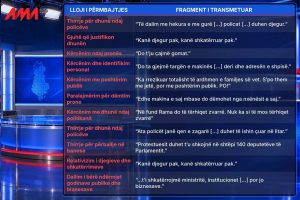
AMA’s monitoring has identified statements such as the following:
“The time has come for civil war. We must take up all the heavy weapons against this police force, grenades, everything we’ve got men!”
“They are a criminal party that must be wiped out by revolution, by an armed overthrow, this government, this parliament.”
“Ulsi Manja should be shot.”
“Where are the children of those cops, where are their families […] I wouldn’t have rested until I went and put dynamite in that house, or threw a bottle of gasoline to burn them all inside.”
“TNT needs to be placed on the Supreme Court.”
“If something has to be burned, burn the minister’s house.”
“Burn down all the banks […] burn down every institution […] starting with Parliament.”
“Break, break whatever you feel like.”
“The protesters should go to the homes of the 140 members of Parliament.”
“They deserved it too. Set them on fire as well. First let’s set the SHQUP here on fire.”
“They should come out with iron bars and stones […] the police […] need to be burned.”
“Those cops are dogs and bastards […] they should have been hanged.”
“In the end, Rama will be dragged away. He can’t help but be dragged away.”
“They’ve burned a little, they’ve destroyed a little.”
“We’ll slash your tires.”
“We know where you are.”
“The teacher has completely jeopardized her own family’s future. I’m not saying with her life, but with public humiliation, YES!”
“And maybe her car will even be damaged by her students.”
“We’ll find the car’s license plate […] even the house address, even the family register.”
“We’ll even pull the knickers from your heads. We’ll even pull the knickers from your wives’ heads.”
The content of these on-screen statements is a fact that cannot be overlooked.
Can calls for civil war, executions, the use of weapons and the burning of families be treated as ordinary political opinions?
Can threatening to identify a school principal’s relatives and home address, or warning that her property could be damaged, be considered criticism of the authority?
These are questions that directly relate to the boundaries of freedom of expression and the responsibility for the content broadcast.
Editorial responsibility does not end when live broadcasting begins.
In one of the monitored cases, after a caller threatened to use dynamite or gasoline to burn the police officers’ family members inside the house, the moderator’s response was: “I understand…”
In another broadcast, after the statement that the prime minister “will be dragged,” the moderator asked, “How will he be dragged?” while the guest repeated, “He can’t help but be dragged.”
In another case, after statements about the family, the vehicle and the address of a school principal, the moderator intervened: “Let’s not make public threats.” The guest replied, “No, it needs to be public, I did it with full responsibility.” All of these situations show why editorial responsibility must be examined in the full context of the broadcast.
A moderator cannot predict every statement from a guest. However, how they react after the statement is made matters.
Do they challenge it? Do they ask for clarification? Do they distance themselves from the call for violence? Do they interrupt? Or do they let it pass without a clear stance?
Editorial responsibility is not a prior restraint on thought. It’s responsibility for the content that television conveys to the public. And this responsibility exists even in live broadcasting.
European Standard: The Case of Latvia
On October 21, 2020, on a Russian channel’s political talk show, a participant called for the leader of the Belarusian opposition to be taken by force from Vilnius and hanged in the central square of Minsk. In February 2021, the Latvian regulator imposed a 12-month ban on the channel’s retransmission, following a series of serious violations related to incitement of violence, hatred and military conflict. The European Commission reviewed the measure and, on May 7, 2021, determined that it was justified, proportionate and in accordance with European Union law. The Commission did not impose the ban itself. It assessed the legality of the measure taken by the Latvian regulatory authority.
The case involved several broadcasts and serious violations, so it cannot be automatically equated with a single statement in an Albanian studio. But it demonstrates an important principle: freedom of the media and the political nature of a debate do not preclude the enforcement of rules against incitement to violence. Equally important is the fact that violence against an individual does not become more acceptable simply because he is a political figure. An opposition leader or a prime minister can be harshly criticized, opposed and called upon to step down from power. But that does not exempt them from protection against incitement to physical violence.
What does the European Court say?
The European Court of Human Rights has determined that freedom of expression is one of the foundations of a democratic society. It also protects statements that shock, offend, or upset, especially when it comes to political criticism and matters of public interest. The Court has made a fundamental distinction between harsh criticism and statements that incite or justify violence.
In its jurisprudence, the Court has emphasized that such statements must be evaluated by taking into account the words used, the political and social context, the manner of dissemination and the possibility of harmful consequences. Media liability has also been the subject of its scrutiny. The Court has recognized the special importance of audiovisual media because of their immediate and powerful impact on the public.
The fact that a statement was made by a guest and not by the journalist does not automatically exclude the media’s responsibility. Nor does its broadcast automatically bring responsibility. The entire editorial context must be examined:
The moderator’s reaction and whether the broadcast informs the public or contributes to the spread and normalization of calls for violence.
Thus, the European standard does not require media silence. It requires that editorial freedom be exercised alongside responsibility for the content presented to the public.
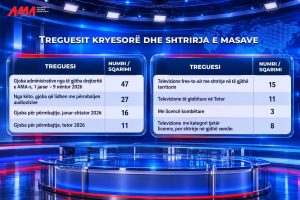
11 of the country’s 15 major television stations
In Albania, there are 15 major television stations that broadcast free-to-air throughout the country’s territory, meaning they reach the public without a fee.
Of these, 11 have aired content flagged in AMA’s monitoring for the cases under discussion. This is a fact that must be taken into account in the debate on media freedom and independence.
On many of these screens, extremely harsh criticism of the government has been broadcast, including calls for armed coups, the burning of institutions and threats against state representatives. This does not in itself prove the media’s full independence, which also depends on other factors. AMA notes that these screens allow for extraordinarily harsh political expression.
Here a fundamental distinction must be made.
Being critical of the government does not exempt you from the application of the law. Receiving a sanction for a specific piece of content does not automatically mean you have been punished for your political stance.
If a violation is detected on one television station, AMA must review it.
If it’s detected on 11 TV stations, it must review all 11 cases.
Selective enforcement of the law would be far more troubling than the number of entities involved in a monitoring procedure.
47 administrative fines during 2026 that refute the theory of a campaign
As of November 9, 2026, AMA has imposed 47 administrative fines, 27 of which are related to broadcast content.
These measures are part of the institution’s ongoing activities.
AMA monitors broadcasts, reviews complaints, identifies possible violations and follows the procedures provided by law. This work did not begin with the protests and does not end with them. The number of fines, taken in isolation, proves neither censorship nor the legality of any decision. Each measure must be evaluated on the basis of evidence, the law and proportionality.
A regulatory authority cannot choose not to act simply because enforcing the law might cause public opposition.
Institutional independence is not proven by failing to make decisions. It’s proven by making well-reasoned, impartial decisions that are subject to review by competent bodies and the courts.
Accountability is to the public
Free-to-air television channels enter citizens’ homes every day.
Their programmes are watched by families, young people and children.
When a call for civil war, for the use of grenades, for execution, or for burning people alive in their homes is made on screen, the statement does not remain confined to the debate’s participants.
It’s transmitted to the public.
It’s precisely for this reason that editorial responsibility exists and the law provides obligations for broadcasters.
AMA has published, for a week now on its official website and social media, videos of the highlighted content.
Citizens can listen to them, assess the context and form their own judgment. The institution’s decisions can be criticized and challenged through legal channels. This is an essential element of the rule of law.
Reviewing content that may incite violence is also a legal obligation.
An independent institution cannot remain silent in the face of violations just because its decisions may be unpopular. A free media cannot abandon its editorial responsibility.
Freedom of expression and critical journalism must be protected!
Calls for violence must not be normalized!